Equipment Selection
This section is meant to give you a general understanding of each component and what should be your approach in purchasing something suitable for your use. It is assumed that you have read up on the basics of equipment set up and tuning. Otherwise, please refer to https://www.eastonarchery.com/img/downloads/software/tuning_guide.pdf .
Recurve Bow Components
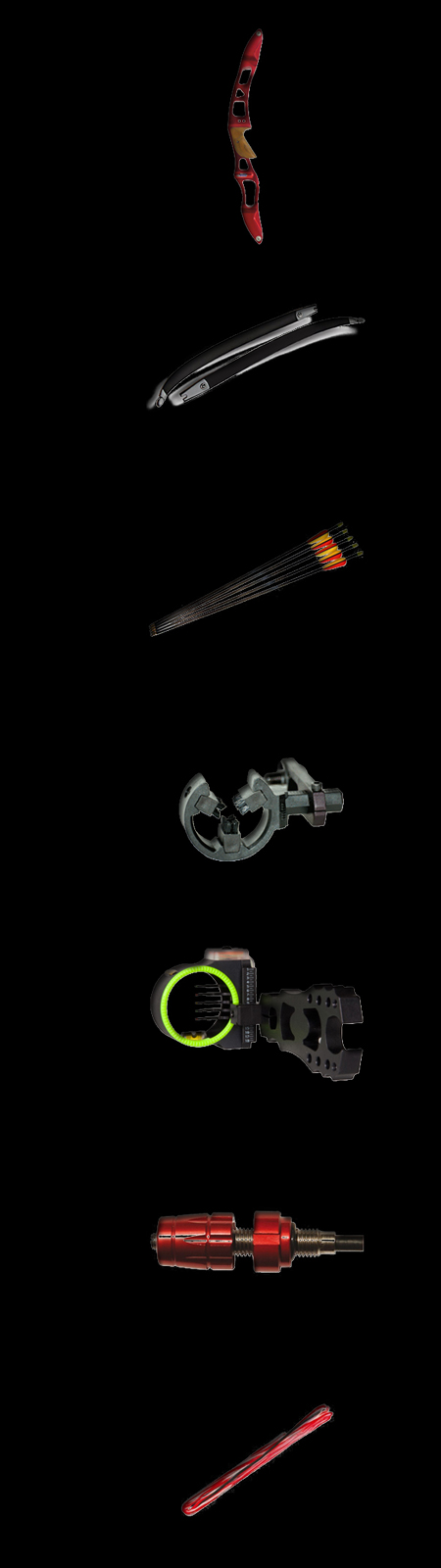
Riser
For those who are serious about archery and/or would like to be competing one day, you should invest in the best riser financially affordable. If you have been watching archery tournaments on YouTube or Archery TV, you will notice many top players using Hoyt and Win & Win. For those who are still not decided – please go with the cheapest available choice.
Limbs
The choice of limbs affects the arrow speed directly. Better limbs made from Carbon materials have better flex capabilities and hence increases arrow speed. The faster the arrow speed, the flatter the trajectory of the arrows and hence less compensation required for gravity. You can still move up the value chain by going for a wooden pair of limbs while you are training for 18 meters and carbon limbs only when you are ready for 30 – 50 meters distances.
Arrows
The most important thing to be mindful of when buying arrows is the spine of the arrow. In order to do that – one would have to know the draw weight and draw length. The spine of the arrow is the stiffness of the arrow and it determines the flex of each arrow when it leaves the bow. According to Archer's Paradox – when an arrow leaves the bow – it flexes sideways. The higher your draw weight – the stiffer the spine required. While you are still in the learning stage, you might want to consider a spine that is one level higher giving yourself room to upgrade your limbs if required. However, you may not want to jump into expensive Carbon or Hybrid arrows unless you are training for competitions. You should practice with the more affordable Aluminium arrows until you are ready.
Arrow Rest
Do not neglect this simple and cheap piece of device. For your first bow, you should be given a cheap plastic rest. My suggestion is to invest in one where the height is adjustable. This will give you the flexibility of using arrows of varying diameter. As the plunger must always be in the centre of the arrow, when you use fatter arrows, the plunger position becomes lower than the centre-line of the arrows. You will need the ability to move the arrow rest lower to compensate for the increase in diameter of the arrows.
Sights
The difference between cheap and expensive sights are the ease of adjustment and its ability to withstand the vibration created while the arrow is released. When you are ready to commit, you might want to look at Sure-Loc or Shibuya.
Plunger
The plunger determines the starting position of the arrow (which is very slightly to the left) – for a right hand bow. It is used for determining the centre shot – which will place the arrow slightly to the outside of the bow string. For advanced archers – the level of stiffness on the plunger – can be used to accommodate arrows of varying stiffness. Without which, you will notice that your shots are either always heading to the left or right no matter how you adjust your sight position.
String
This is also a very important component of the entire bow setup. The cheaper string may stretch over time and might make your brace height shorter. Better strings such as Fast Flight or Astro Flight are faster, hence reducing the trajectory of the arrows and will be less susceptible to stretching.
Other Components
Items such as finger tabs, arm guards and chest guards are really personal. Hence, it is important to be comfortable when you wear them. Items such as quivers, bow stands and cases are really personal preferences.